
Continuing Education
DermoNeuroModulation (DNM) 4-Day Intensive — Sept 15–18, 2026
DermoNeuroModulation (DNM) 4-Day Intensive — Sept 15–18, 2026
DermoNeuroModulation (DNM) 4-Day Intensive
September 15–18, 2026 (Tues–Fri) · Surrey, BC · 14 participants
Tuition
$995 if registered by June 30, 2026. $1,195 from July 1 onward. Past DNM students: $995 with code DNMALUMNI. Tuition includes all 4 days of instruction and course materials. Travel, accommodation, and meals are not included.
A rebuilt course
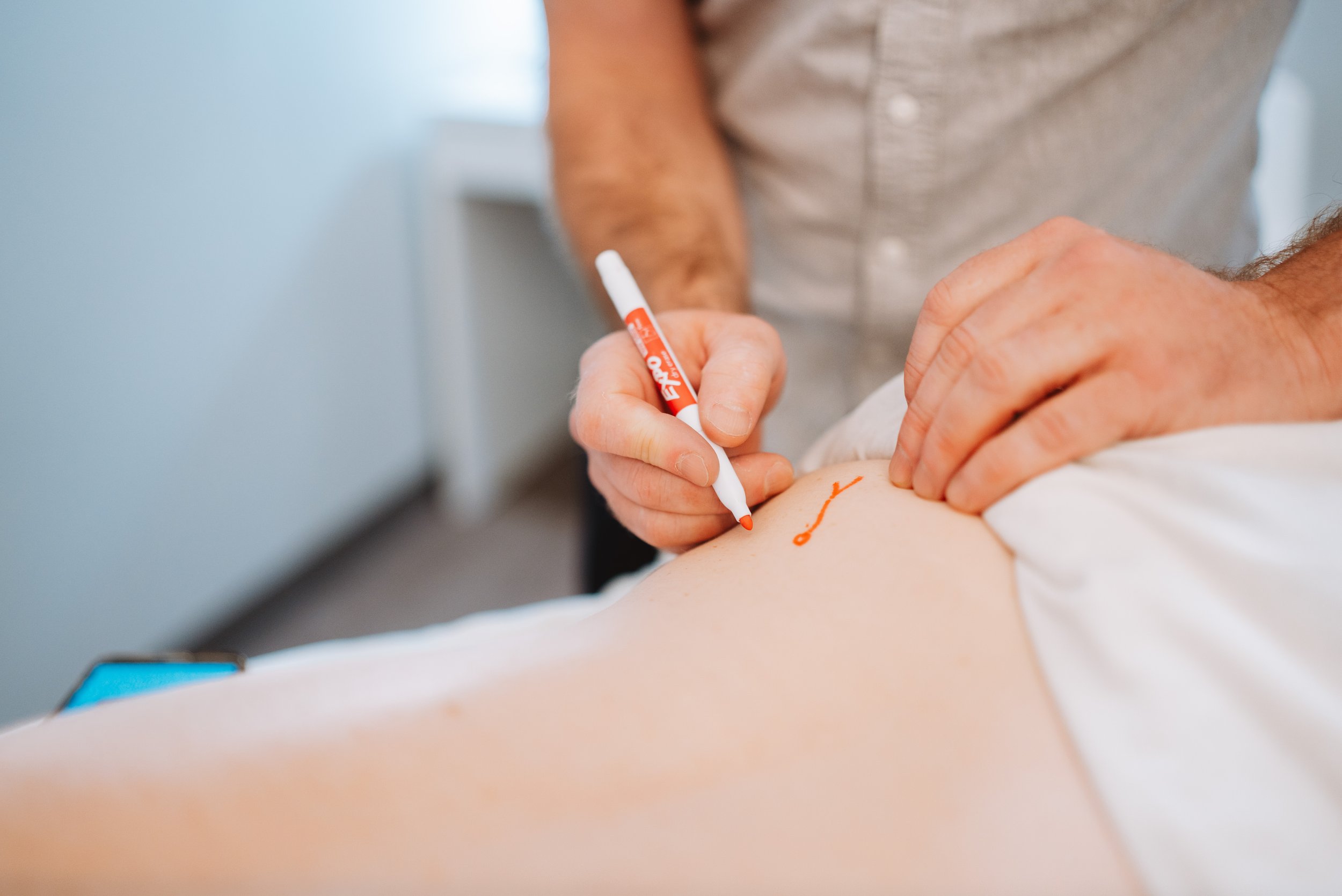
Most RMTs were trained on models that don't hold up — trigger points, fascial release, joint subluxations as primary mechanisms of effect. Day 1 starts there, with a critical look at what we got wrong and why it matters in the room with a patient. From there, the course rebuilds the framework: neurodynamics (popularized by Michael Shacklock and David Butler), Simple Contact (developed by the late Barrett Dorko, PT), and DermoNeuroModulation (developed by Diane Jacobs, PT). Three approaches taught as one integrated 4-day system, with the majority of class time spent in supervised lab. The result is a hands-on practice that is gentle, neurologically grounded, and clinically defensible.
What participants work on
Pain science and clinical communication
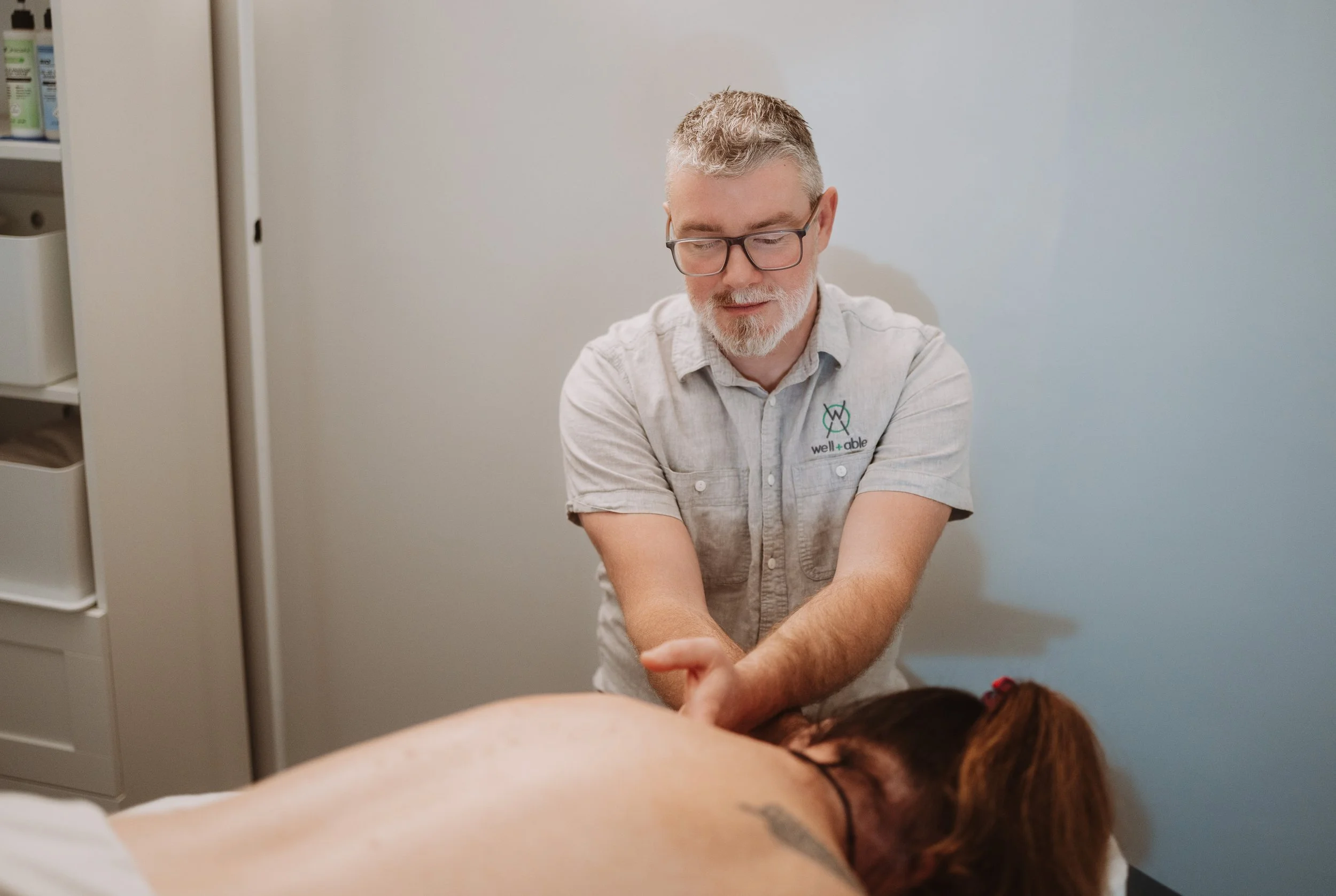
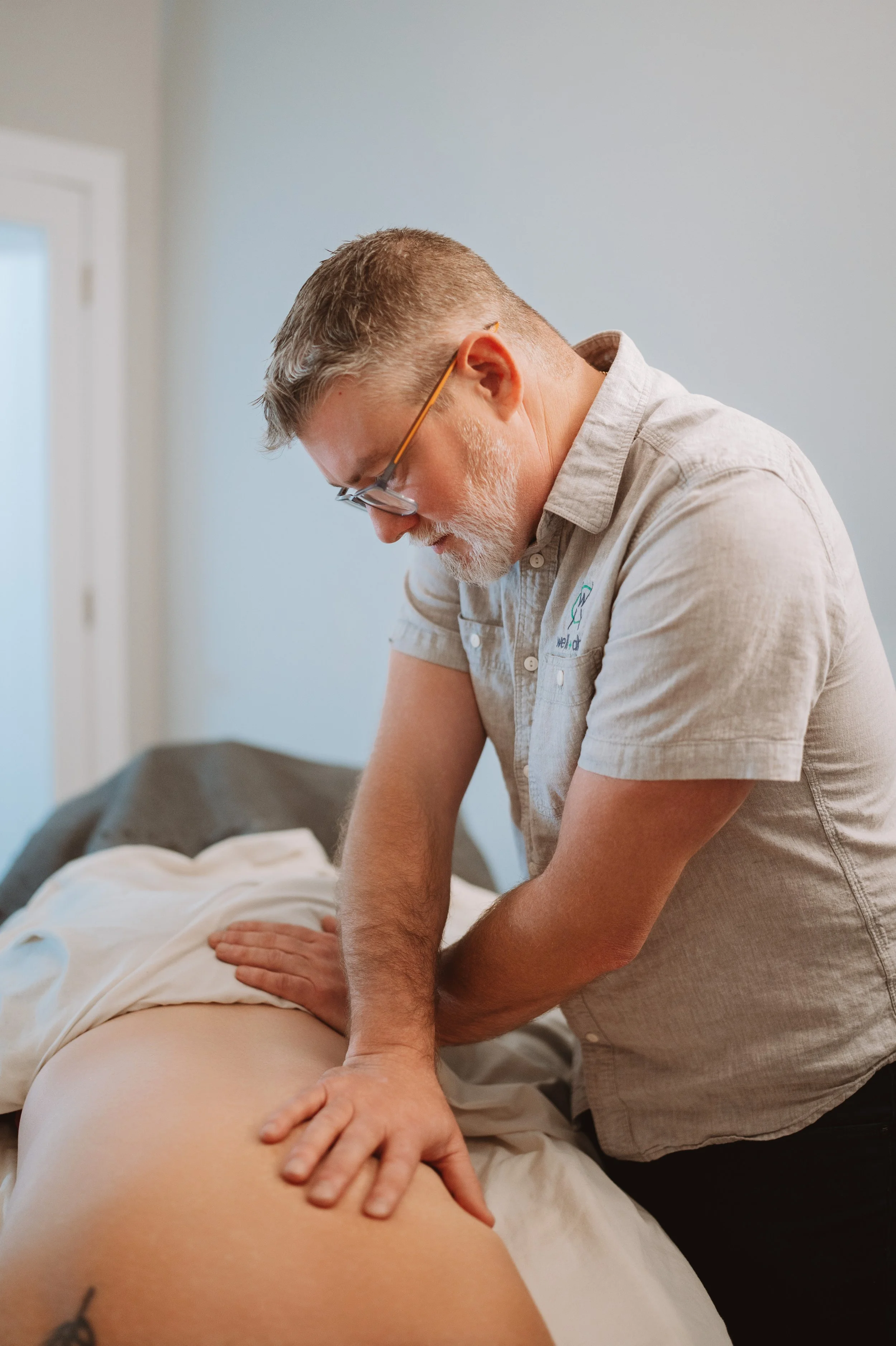
A working DNM toolkit, practiced under supervision
Integration of touch, communication, and movement within a session
Clinical reasoning for patients with persistent pain
Format
Small group, 14 participants. Hands-on, lab-heavy, with direct coaching throughout. Participants partner with other clinicians and receive real-time feedback.
Learning outcomes — DNM 4-Day Intensive
By the end of this course, participants will be able to:
Describe the major models of pain and state what each one predicts and where it fails.
Explain why several widely taught explanations for musculoskeletal pain — trigger points, fascial restriction, postural correction — are no longer supported, and what that means for treatment choices.
Distinguish between the causes and the origins of pain, and name the four origins.
Use a patient's pain distribution, behaviour and duration to form a working hypothesis about origin, and state what would disconfirm it.
Describe the difference between operator and interactor approaches, and identify which one a given clinical decision reflects.
Explain how contextual factors and language influence a treatment encounter, and identify nocebo language in their own practice.
Perform Simple Contact, and recognise ideomotion when it occurs.
Explain why DNM is described as an approach rather than a technique, and what follows from that distinction in a treatment encounter.
Describe the neuroanatomy of skin relevant to manual contact — cutaneous nerves, skin ligaments, mechanoreceptors — and state the proposed mechanism of DNM.
Apply the handling principles of DNM: skin as the primary point of contact, sustained lateral stretch, shortening and widening the tunnel around a nerve, and working within a range that stays comfortable.
Locate and treat cutaneous nerves of the back, neck, thorax, pelvis and limbs.
Follow the principles of DNM through a complete treatment encounter, selecting where to work and adapting to the patient's response, and explain the reasoning behind each choice.
Perform upper and lower limb neurodynamic tests and interpret the findings.
Apply neurodynamic techniques as treatment, selected on the basis of test findings.
Integrate assessment, model selection and handling into a complete patient encounter, and justify each decision made.
Course structure
Day 1 — Foundation
9:00 Intro, introductions
9:20 L1 — old models and why they failed
10:05 Break
10:20 L2 — pain models
11:05 L3 — assessment: operator/interactor, causes vs origins, four origins, mechanism patterns
11:50 Lunch
12:50 L4 — non-specific effects, nocebo, ideomotion
1:35 Break
1:50 Simple Contact demo and practice
4:00 End
Day 2 — Skin and DNM upper
9:00 L5 — skin, touch, cutaneous neuroanatomy
9:45 DNM back and neck
11:50 Lunch
12:50 DNM back and neck, continued
4:00 End
Day 3 — Nerves and DNM lower
9:00 L6 — peripheral nerves, mechanosensitivity
9:45 Neurodynamic testing lab
11:50 Lunch
12:50 DNM hip, pelvis, lower limb
4:00 End
Day 4 — Integration
9:00 DNM arms and remaining regions
10:45 Neurodynamics as treatment
11:50 Lunch
12:50 Neurodynamic treatment, continued
2:00 Case studies — full encounters, all three methods
4:00 Close
Coffee breaks mid-morning and mid-afternoon each day
Location
Bodhi Tree Teaching Centre
#212 - 17696 65A Avenue
Surrey, BC.